Found your tribe? Join the Guest List
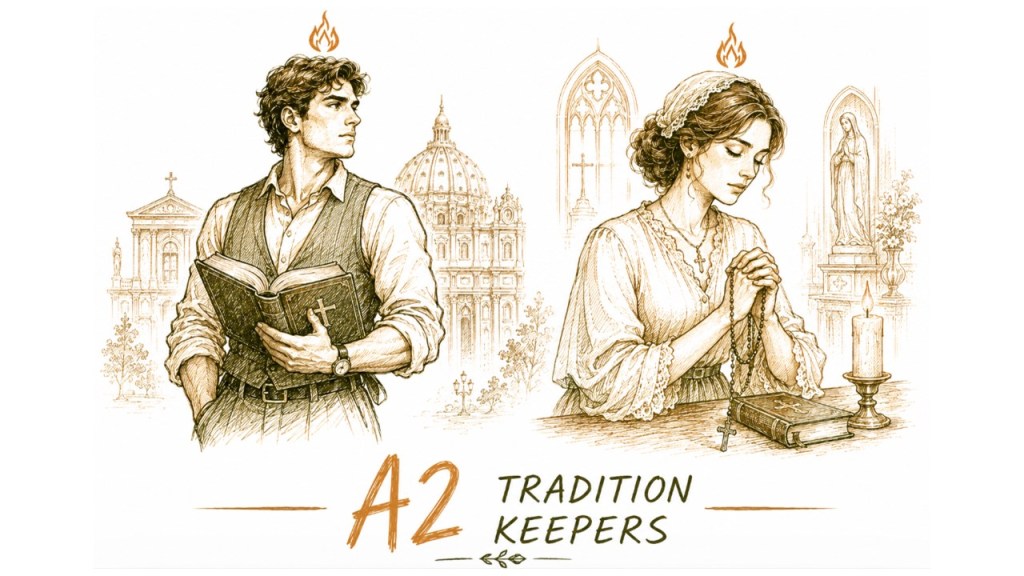
“Tradition is not the worship of ashes, but the preservation of fire.”
Introduction
The Tradition Keepers protect the wisdom, beauty, symbolism, and sacred inheritance of the Church. They are often drawn toward the sacraments, liturgy, structure, reverence, and continuity across generations. Like guardians of the temple lamp, they help preserve what is holy so it is not lost or diluted by time, relativism, or cultural pressure. Their gift is helping anchor the Church in truth, beauty, and sacred order. Without Tradition Keepers, the Church forgets where it came from.
Socially, A2’s often gravitate toward communities that possess a strong sense of identity, continuity, and shared religious or civic values, often more formal environments, and less casual. You will often find them at family gatherings, feast day celebrations, formal dinners, parish events, or local community events. Many A2s also tend to stay relatively rooted geographically, though Rome and religious pilgrimages likely excite them, they are often more likely to build their lives close to family, familiar traditions, and close friends. They are often less energized by highly chaotic social scenes, nightlife, or environments that feel secular. More than excitement, Tradition Keepers are looking for belonging that can endure.
Key Phrase
“The Rosary is the book of the blind, where souls see and there enact the greatest drama of love the world has ever known.”
— Archbishop Fulton J. Sheen
Description
Tradition Keepers understand that faith is not invented by every generation. It is received, stewarded, lived, and handed on. They instinctively recognize that many of the most beautiful things in life, from family and social traditions to sacred liturgy and theological norms, exist because someone cared enough to preserve them.
A2’s are naturally attentive to the rituals, practices, symbols, and institutions that communicate deeper truths. They are often drawn toward theology, sacred art, church history, family customs, liturgy, architecture, feast days, devotions, and the wisdom of those who came before them. While others may focus on innovation or adaptation, Tradition Keepers instinctively ask what is worth preserving.
They understand that culture is not built in a day. The strongest civilizations, families, and communities are often built upon habits, traditions, and truths that have survived generations of testing. Because of this, they often become guardians of memory and continuity within their families, parishes, ministries, and friendships.
Many Tradition Keepers possess a strong sense of responsibility toward future generations. They care deeply about passing on what is good, true, and beautiful. They often feel burdened by the loss of traditions, institutions, and moral foundations that once helped communities flourish. In a world constantly chasing novelty and reinvention, Tradition Keepers remind the Church that roots matter.
At their best, they help others discover that tradition is not about living in the past. It is about carrying timeless truths into the future. They understand that the treasures of Christianity are not museum pieces to be admired from a distance, but living gifts meant to be received, lived, and passed on.
“I feel most at home in places that have stood the test of time.”
Natural Gifts
- Reverence: Deep appreciation for what is sacred, holy, and worthy of honor
- Structure: Ability to create order, stability and long-term consistency
- Stewardship: Desire to preserve and protect what is good, true, and beautiful
- Wisdom: Respect for lessons learned across generations
- Discipline: Commitment to faithfulness even when enthusiasm fades
- Beauty: Appreciation for architecture, symbolism, aesthetics, ceremony, and meaningful traditions
Potential Blind Spots
- Rigidity: May sometimes struggle to distinguish eternal truths from personal preferences or cultural customs
- Nostalgia: May idealize the past while overlooking the good God is doing in the present
- Gatekeeping: May unintentionally make faith feel harder to approach for newcomers than Christ intended
- Preservation: May focus so much on protecting treasures that they hesitate to take necessary risks
- Correctness: May sometimes prioritize being right over being relational
- Control: May struggle when change is necessary, even when the mission itself remains unchanged
Often Thrive In
Activities
- Theology studies
- Pilgrimages
- Liturgical celebrations
- Historical tours
- Family feast days and traditions
Hobbies
- Reading theology and history
- Sacred music and group rosary prayers
- Traditional crafts
- Genealogy
- Collecting books, art, or religious artifacts
Work
- Education
- Law
- Accounting
- Church leadership
- Preservation and cultural institutions
Social Settings
- Formal dinners
- Family gatherings
- Study groups
- Parish events
- Structured communities
Environments
- Historic churches
- Libraries
- Monasteries
- Universities
- Traditional family homes
- Places rich in history and symbolism
Friendship Recommendations
Tradition Keepers often connect naturally with A1s who share their love for reverence and spiritual depth, and with B2s who appreciate beauty, hospitality, and intentional culture-building. They tend to thrive around people who value loyalty, consistency, meaningful traditions, and long-term commitment.
Many of their deepest friendships are formed through shared values rather than shared interests. They are often less interested in novelty and more interested in finding people they can build something enduring with.
Dating & Marriage Recommendations
A2 + A2
Often a strong match built on shared values, traditions, vision, and commitment to family life. Their challenge is ensuring their home remains joyful and welcoming rather than becoming overly rigid or perfectionistic.
A2 + A1
Often a deeply complementary pairing. A2s bring structure, stability, and clarity, while A1s bring warmth, tenderness, and spiritual intimacy. Together they often create homes that are both rooted and alive.
A2 + B2
Often an excellent pairing. B2s help Tradition Keepers engage the broader world with greater hospitality and relational ease, while A2s help keep the relationship grounded in enduring values and purpose.
Protestant Converts
Many A2s feel a particular affinity for more deeply prayerful protestant converts who discovered Catholicism through history, theology, and tradition. Their shared appreciation for doctrine, continuity, and the intellectual foundations of the faith often creates strong friendships and mutual respect.
Saints, Biblical Archetypes & Heroes
Saints
- St. Benedict
- St. Thomas Aquinas
- St. Teresa of Ávila
- St. John Henry Newman
Biblical Archetypes
- St. Joseph
- Ezra the Scribe
- Nehemiah
- The Levites guarding the Temple
Historical Heroes
- Pope Benedict XVI
- G.K. Chesterton
- J.R.R. Tolkien
- Charlemagne
Fictional Heroes
- Aragorn
- Obi-Wan Kenobi
- Uncle Iroh
- Mufasa
- Albus Dumbledore
Ministry Recommendations
- RCIA / OCIA
- Catechesis
- Theology Formation
- Liturgy Ministry
- Marriage Preparation
- Parish Leadership
- Sacred Art & Architecture
- Family Life Ministries
How You Build the Kingdom
Tradition Keepers help preserve the wisdom, beauty, and sacred inheritance of the faith. They ensure that future generations receive not only sound doctrine, but also the stories, customs, rituals, symbols, and traditions that make Christianity tangible and lived.
When others are focused on what is new, Tradition Keepers remind the Church of what must never be lost. They help keep the roots healthy so that future generations can continue to grow.
Reflection Question
“Am I preserving traditions because they help people encounter God, or because they help me feel safe and familiar?”
Not sure if this is you?
Check out the 5 other Social Temperaments here.
Want to meet others who share this temperament?
Join our free Guest List to be considered for future Society of the 12 experiences.

