Catholic Temperaments Quiz

Discover the environments, cultures and people where your soul naturally flourishes. It’s 100% free, we just want to help connect you to others like you.
Step 1: Take the Quiz

Takes under 12 minutes, 60 questions. We do not have access to your answers, so take a screenshot of your result and feel free to share it.


Step 2: Read Your Assessment

You’ll get a full description of your temperament, including strengths, blind spots, saints, historical figures, lifestyle, and social preferences. Not sure you got the right one? Check out the rest here.


Step 3: Join our Guest List

Now that you know your tribe, let us connect you with people like you, still 100% free. We curate introductions for guests, Dinners for 12, local gatherings, group trips, and tribe-based experiences near you:


Catholic Temperament Explanation

Is it OK to passionately kiss before marriage?

One Catholic thinks tequila shots are scandalous, another hosts Theology on Tap, one Catholic thinks modesty means avoiding sleeveless shirts, another trains for the Olympics in sports bras, both genuinely pursuing holiness.

See, there are different paths to sainthood (as evident by the many different types of saints). There are different spiritual gifts, different charisms, different experiences that shape each of our paths in different ways, different manifestations of the same Spirit of truth, goodness, and beauty.

As Pentecost Sunday reminded us (1 Corinthians 12:3b-7, 12-13):

“There are different kinds of spiritual gifts but the same Spirit;
there are different forms of service but the same Lord;
there are different workings but the same God who produces all of them in everyone.
To each individual the manifestation of the Spirit is given for some benefit.

As a body is one though it has many parts,
and all the parts of the body, though many, are one body,
so also Christ.”

So, while there is one fundamental Spirit, it often seems that we become divided and judge or misunderstand each other because our different spiritual gifts, forms of service, workings, or manifestations of the Spirit get lost in… language.

Language as a symbol for different cultures, personalities, temperaments, and even love languages. When we say “now you’re speaking my language,” we often mean: now you are talking to me about things that are culturally meaningful, relevant, motivating, attractive, or emotionally resonant to me.

For Catholics, the ability to speak in different tongues/languages is not just (or even primarily) about the ability to speak Spanish, English, French, etc, but perhaps more about the ability to understand and communicate with different people, different tribes, different cultures, and different temperaments in ways that resonate with THEM.

Unfortunately, many Christians struggle with this, some try reading Bible verses in debates about science, others use speakerphones to yell repentance at college kids outside bars, both often end up sounding like gibberish or a foreign tongue to their intended audience. One of the great gifts of the Holy Spirit is the ability to communicate with different “tribes” or social temperaments, in the language that will best captivate them.

Even many modern Catholic controversies are not actually arguments about doctrine itself as much as arguments about aesthetics, culture, boundaries, evangelization style, and different spiritual sensitivities.

Which takes us back Pentecost Sunday (Acts 2:1-11):

(…)
And they were all filled with the Holy Spirit and began to speak in different tongues, as the Spirit enabled them to proclaim.
(…)
At this sound, they gathered in a large crowd, but they were confused
because each one heard them speaking in his own language. They were astounded, and in amazement they asked, “Are not all these people who are speaking Galileans? Then how does each of us hear them in his native language? We are Parthians, Medes, and Elamites, inhabitants of Mesopotamia, Judea and Cappadocia, Pontus and Asia, Phrygia and Pamphylia, Egypt and the districts of Libya near Cyrene, as well as travelers from Rome, both Jews and converts to Judaism, Cretans and Arabs, yet we hear them speaking in our own tongues of the mighty acts of God.”

Pentecost was not the elimination of differences. It was the miracle that radically different people could suddenly understand one another through the same Spirit.  

So we created a Quiz.

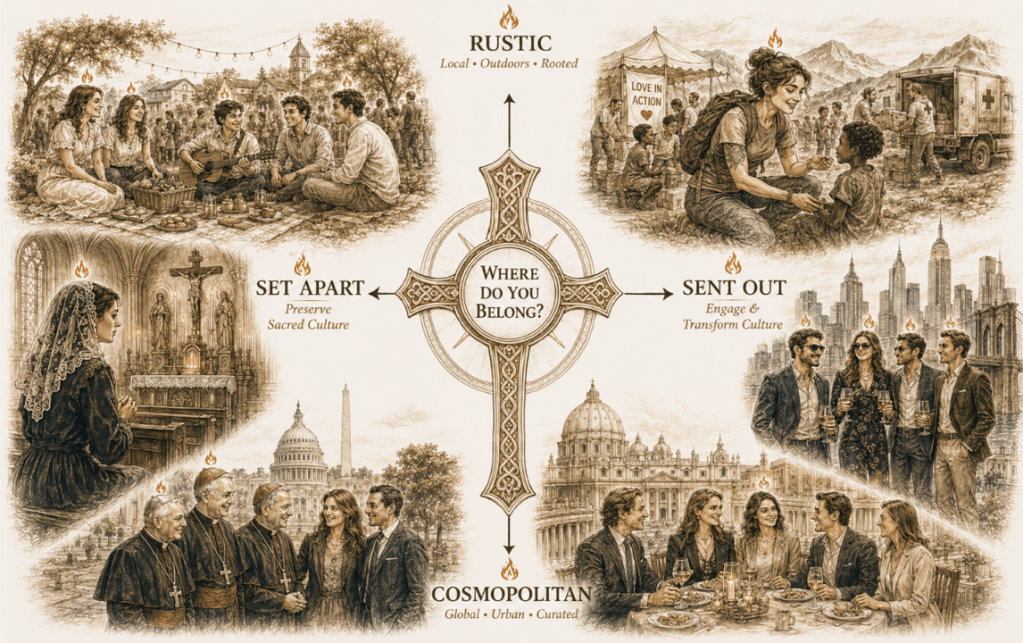
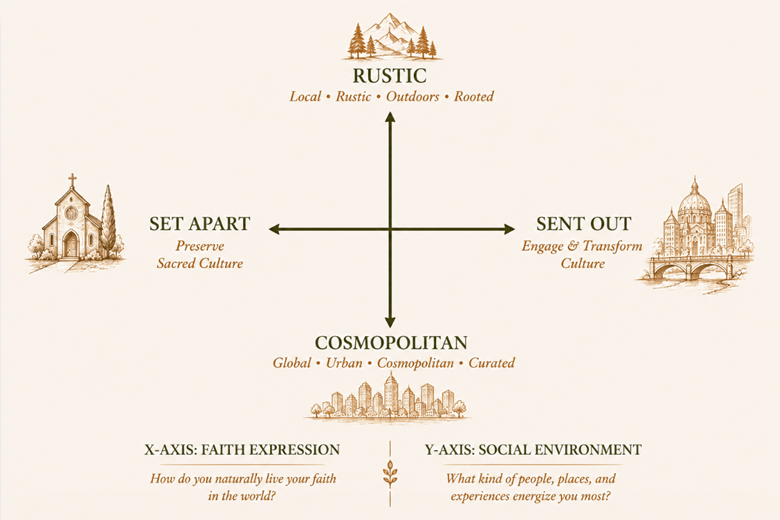
The quiz is simply trying to map the different spiritual-social languages Catholics tend to speak. We have 2 axis:

X Axis: SENT OUT ↔ SET APART

Some Catholics feel deeply called to be SENT OUT, to engage culture, to evangelize through immersion, to sit at tables with sinners and tax collectors, to go into difficult spaces without fear, to influence from within, to build bridges, to meet people where they are. This was often the spirit of missionaries, evangelists, public witnesses, and even Christ himself at moments like the wedding at Cana.

Others feel deeply called to be SET APART. To preserve reverence, silence, modesty, discipline, purity, boundaries, and protection from temptation. To cultivate sacred space. To withdraw from worldly chaos in order to remain focused on God. This was often the spirit of monks, hermits, contemplatives, ascetics, and communities intentionally separated from worldly influence.

It is important to note: both paths can lead to sainthood, both are found throughout Scripture, both are found throughout Church history, both are manifestations of the same Spirit.

Y Axis: RUSTIC ↔ COSMOPOLITAN

Some Catholics feel most alive around simplicity, nature, slower rhythms, practical life, local community, ranches, simplicity, tradition, and grounded culture. Others feel energized by cities, diversity, fashion, art, intellectual life, travel, sophistication, ambition, business, nightlife, and complex social environments.

And interestingly, we even see this tension reflected in Scripture itself. In the Pentecost reading, people gathered from radically different regions and cultures: Romans, Arabs, Egyptians, travelers from across the known world.

Some came from simpler provincial cultures like Galilee, others came from cosmopolitan centers like Rome itself, and evangelizing Rome required a VERY different language, symbolism, attitude, and social behavior than preaching to fishermen in Galilee.

And perhaps one of the painful realities many young Catholics experience today is this: sometimes we keep trying to force deep friendship, community, or romantic compatibility with people who are genuinely GOOD Catholics… but who simply speak an entirely different spiritual-social language than we do.

Different convictions around modesty, romance, nightlife, affection, alcohol, emotional expression, masculinity, femininity, fitness culture, family culture, and social boundaries. And eventually many people discover: compatibility is not just about theology…it’s also about temperament.

The 6 Possible Results

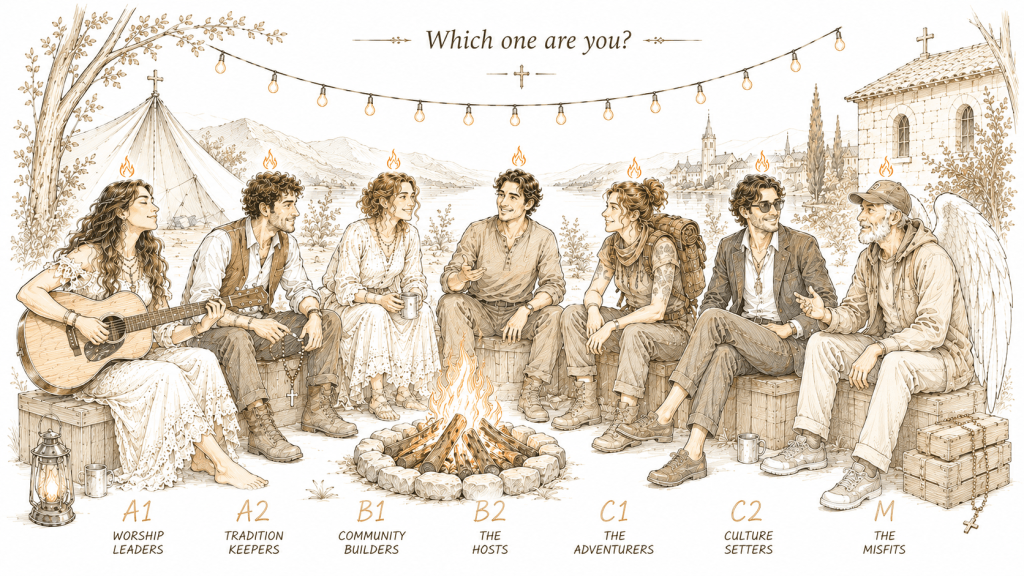
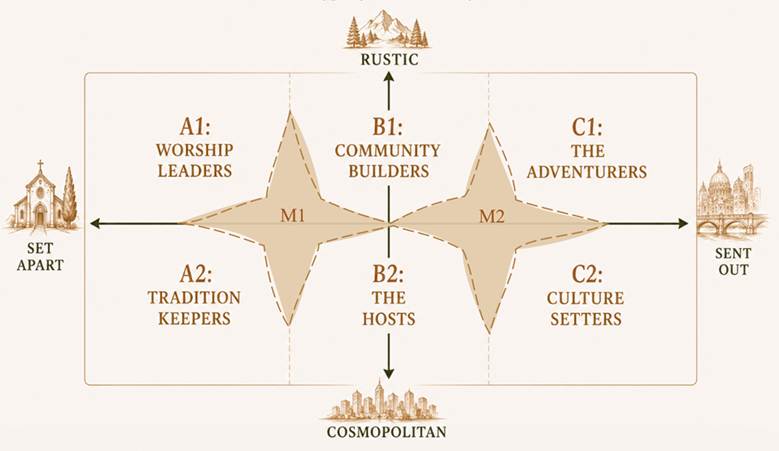
And so, there are 6 temperaments (with a shade of a 7th).

  • A1: Worship Leaders
  • A2: Tradition Keepers
  • B1: Community Builders
  • B2: Hosts
  • C1: Adventurers
  • C2: Culture Setters

The 7th is less clear cut area, an M Temperament ( M1 / M2), these are Catholics so close to several quadrants that it is often difficult to fit in in any of them, but can adapt to several, these are the “Catholic Misfits” sections, they are often able to serve as bridges between tribes.
This is why we’re called Society of the 12:

6 temperaments x 2 genders = 12 tribes

Not to divide Catholics into competing camps, but to help people better understand themselves, understand where they naturally fit in socially, what dinners, hangouts, retreats, pilgrimages, events they’d likely enjoy more, to build stronger friendships, relationships, communities, and missions, with greater awareness of their own Catholic Temperament.

Once you take the quiz, don’t forget to join our Guest List to be considered for curated introductions and events near you: